
Go Vertical
AIRO installed an AI brain into an Auckland event hire business: it knows the business inside out, it's connected to the tools they already run on, and it does the admin work while Graeme stays in control.

The client
Go Vertical — event and equipment hire, Auckland. Run by Graeme Wallace, with three to four regular contractors and around thirty subcontractors called on across events. Inflatables, obstacle courses and activity hire for schools, corporates, councils and community events.
An established business with real revenue and a full calendar — held together by manual work. Not a tech company, and no interest in becoming one. Exactly the kind of business AIRO is built for.
The problem
Graeme wasn't disorganised. He'd accumulated tools the way every small business does: one at a time, over years, none of them talking to each other.
Six systems, zero connection
Email in two places, calendar in another, the product list in a database, accounts in Xero, and the website separate from all of it.
Pricing lived in his head
Nowhere else. That made quoting slow, made it inconsistent, and made it impossible for anyone else to do.
The website couldn’t show what the business sells
A full product catalogue existed — customers just couldn’t see it. Every enquiry meant a phone call or an email, answered by hand.
Quoting was a whole job
Read the enquiry, price it from memory, write the quote, chase the acceptance, write the agreement, raise the invoice. Every step manual, every time.
What an AI brain actually is
Not a chatbot on a website. An AI brain is a single, complete picture of how your business works — what you sell, what it costs, who buys it, how you talk to them — connected to the systems you already run on and given the job of doing the admin.
It is the difference between an assistant that gives useful-sounding but wrong answers, and one that responds like it has worked for you for years. Everything AIRO builds afterwards plugs into it, which is why the second thing a business asks for always arrives faster than the first.
It knows your business
Your services, your pricing, your customers, the way you write to them, the things you would never say. Answers come out of your actual business rather than off the internet.
It plugs into what you already use
Your email, your calendar, your product list, your accounts. Nothing gets replaced and nothing new gets learned — the tools you already have start working together.
It does the writing
Enquiry replies, quotes, agreements, invoices, follow-ups. The typing, the remembering and the chasing between stages stop being your job.
You stay in charge of everything
It drafts, you send. It never touches money without your say-so on that exact action. Nothing customer-facing goes out unless you have read it.
It gets better at your business over time
Every new job plugs into the same brain instead of starting from scratch, so the second thing you ask for is faster to build than the first.
It belongs to you
You can read exactly what it knows, change it, and nothing goes into it without you knowing. It is not a black box you rent.
What follows is that install, done for one Auckland business — and everything it has been put to work on since.
Discovery: a sit-down, not a sales pitch
No laptop, no slides, no product to push. The whole first session was Graeme talking and me listening: how enquiries come in, how he decides pricing, how a job actually runs on the day, where the week disappears. What annoys him. What he'd stop doing tomorrow if he could.
That conversation is where the plan came from — not from a template. Graeme knows his business. I know AI. The plan needed both, and it wouldn't have been the right plan if it had been written before the conversation.
Building Graeme's brain
Same day, a structured interview — around thirty questions covering services, equipment, pricing logic, customer types, contractors, suppliers, how Graeme writes to customers, what he'd never say to a customer, and what matters most this year.
This is the actual product. Not the website work, not the invoicing — those are things the brain was later asked to do. The brain is what makes each of them take days instead of months. Graeme has read his, can see it any time, and nothing goes into it without him knowing.
The install: connecting it to the business
The guardrails were set at install, not bolted on afterwards
- It drafts, Graeme sends. Nothing customer-facing goes out without him reading it first.
- Nothing is written to the accounts without his approval on that specific action.
- Invoices are only ever created as drafts.
- It never deletes anything, and it never touches bank details.
- Anything ambiguous — especially pricing — comes back to him rather than being guessed at.
The point of the guardrails isn't caution for its own sake. It's that a business owner will only actually use a system he trusts, and trust comes from knowing it can't do anything behind his back.
What the brain has been put to work on
Each of these was built on top of the same brain rather than from scratch, which is why they arrived in days rather than months.
Website product finder
44 products sat in an internal database. The website showed almost none of them.
The website reads the product list live. Tick a box against a product and it appears on the site. Change a price and the site changes. Customers browse and filter by budget, indoor or outdoor, and available space, then send one enquiry for several items at once.
The database is now the single source of truth — so the website stops drifting out of date, permanently.
Custom dictation tool
Graeme types slowly and works from his phone and van as much as his desk.
Hold one key, talk, and the words appear in whatever he’s working in. Runs entirely on his own machine, costs nothing to run, and was tuned to get his industry’s words and his customers’ names right.
Built and delivered the same day it was scoped — not because it was on a roadmap, but because it was a real friction he mentioned in passing.
Quote-to-invoice automation
Every enquiry meant pricing from memory, writing the quote, chasing acceptance, then the agreement, then the invoice.
An enquiry now runs end to end: the AI reads the thread and works out what stage it’s at, produces a branded quote, generates a Letter of Agreement on acceptance, then prepares a draft invoice in Xero for Graeme to check and send.
Proven end to end on 16 July, and now running on real customer enquiries. Every customer-facing step is still a draft and every accounting step still needs his approval — he removed the typing, not the control.
Underneath all of it — the foundations
Less visible, and more important than any single tool:
- Pricing moved out of Graeme’s head into a structured product catalogue, with customer-facing descriptions and matching accounting codes.
- A quote pipeline with proper reference numbers and clear stages — draft, sent, accepted, agreement out, invoiced. He can see where every job sits.
- The full working calendar brought in from Outlook: 66 bookings and 76 admin reminders, in one place instead of scattered.
- Consistent invoicing conventions, so every invoice reads the same and reconciles cleanly.
Where it stands
The straight version, because prospects ask and I'd rather answer honestly.
Live and running on real work
- Quote-to-invoice automation running on real customers, end to end
- Product finder on govertical.co.nz — live since 8 July, 44 products
- Product catalogue and quote pipeline in daily use
- Accounting connected, draft-only
- Calendar consolidated — 66 bookings and 76 reminders in one place
- Extended to a staff member, who now has their own access
Next phase
- Marketing: Google Business Profile, a review engine hooked into the invoicing pipeline so every completed job asks for a review, product photography, trust signals on the site, and re-engaging past clients.
Known and being worked
- Product photography is the biggest remaining gap — the finder works, but most products have no image yet
- The website is mid-move to Graeme’s own hosting; the final switchover is waiting on access held by a previous developer
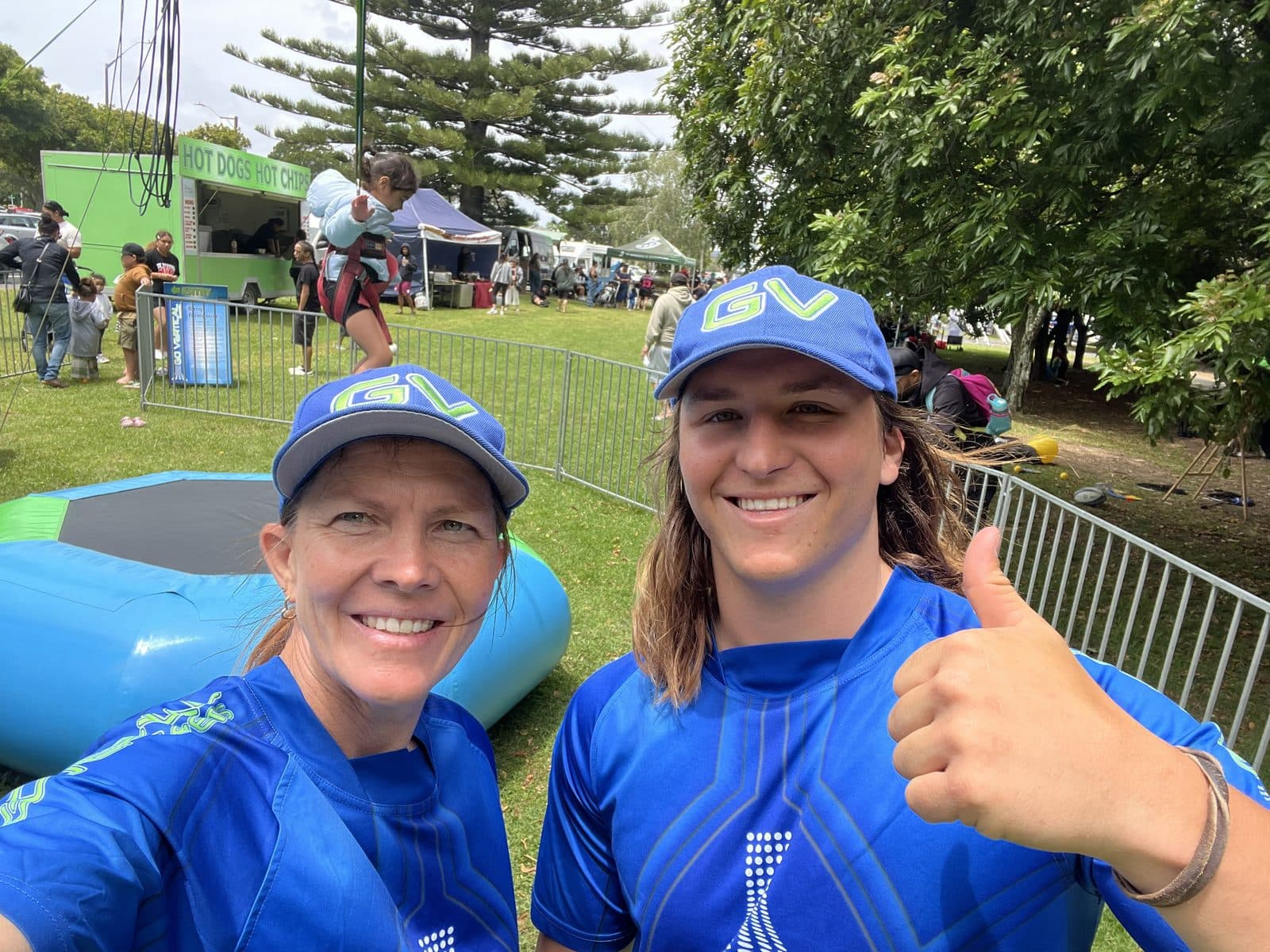
What this looks like day to day
- An enquiry arrives and a sensible reply is already drafted, priced correctly, waiting for him to read and send.
- A customer asks what’s available for 200 kids on grass — the answer comes from his actual product list, not a guess.
- The website is right, because it’s reading the same list he already maintains.
- He talks instead of typing.
- He hasn’t added a seventh tool. The six he had now work as one.
He put a staff member on it too
Graeme has since paid for a second seat and given one of his employees their own access to the system.
Nobody spends their own money extending something they are politely tolerating. A client choosing to widen it to their staff, unprompted, says more than any before-and-after number I could put on this page.
What AIRO learned
The honest version, kept here because the whole point of a first client is what it teaches you.
01Decide the platform before you build on it
The website platform question stayed open for weeks while work carried on around it. Resolving it unblocked everything immediately. On future installs that decision gets made during discovery.
02The bottleneck is rarely the technology
The product finder was built in days. Getting photographs of 44 products is what’s actually holding the website back — and no amount of AI solves that.
03“Built” is not “in use”
The invoicing automation was finished in July but sat unused for weeks, because a mailbox wasn’t connected. It runs on real customers now — but nothing counted until it did, and future installs finish on the live inbox rather than a test one.
04Small friction is worth fixing
The dictation tool wasn’t on any plan. It came from an offhand comment, and it’s the kind of thing that makes someone actually enjoy using the system.
05Guardrails sell the thing
The moment the rules were explained — it drafts, you send, it never touches the money — the conversation changed from “is this safe” to “what else can it do”.
Same thing, your business
It starts the same way this did — a conversation about what's actually annoying you, before anyone mentions software.